 gfield, MO since 1888. Now home, my head is reeling creative thinking.
The lecturer was Ken Hubbard who is a landscape photographer employed by Tamron, naturally to promote and sell their lenses.
A number of general tips were shared with the group, which I will share; some of these are second nature to those with the artistic eye, others, like me have to work at it.
There was also a lot of technical jargon that most of you would not be interested in, nor are we all using the same kinds of cameras.

These tips are ways to make stronger pictures.
The number one point he made several times: When you have made the picture you wanted, stand and look 360 degrees around you. Ninety per cent of the time there will be at least one other picture you missed, had you not taken these few seconds. He had a series of three beautiful mountain pictures with fog, two of which were found with this same advice.
Let lines direct the viewers attention to the main s
 ubject. Lines may be roads, railroad tracks, ridge of rock, fences, or even tire tracks, or a path mowed in a field. [Note the wood fence in the photos I made of Bull Shoals Dam.]
Color directs the eye to the central point of a picture. Imagine a bushel of Granny Smith apples, and one Red Delicious: which one draws the attention?
When taking macros, and WOW! there some good macros out there among you, be sure to focus on the exact part you wish to be sharp because the depth of field (part of picture in focus) is as little as 1/4th inch.
Actually depth of field or lack thereof, can lead the eye to the principal subject. If most of picture is out of focus, the eye naturally looks for what it sees easily.
There is a artist rule called the rule of thirds like 1/3 sky, 1/3 mid range, 1/3 foreground. It isn't quite that simple, but artists and photographers use it. And if 1/3 is a sky with NO clouds, adjust your thirds, so to speak. But if the picture is divided in thirds vertically and horizontally, then the principal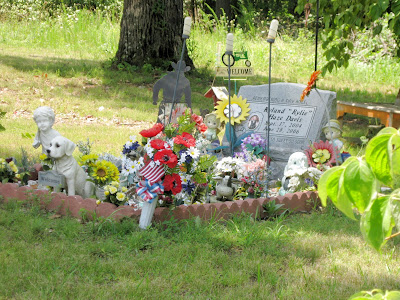 interest of the picture should be at any intersection of these grid lines.
There is a artist rule called the rule of thirds like 1/3 sky, 1/3 mid range, 1/3 foreground. It isn't quite that simple, but artists and photographers use it. And if 1/3 is a sky with NO clouds, adjust your thirds, so to speak. But if the picture is divided in thirds vertically and horizontally, then the principal
 interest of the picture should be at any intersection of these grid lines.
In general, the best picture, photo or painting, leads the eye from some edge into the picture's point of interest and then out again.
Anyway, rules can sometimes be broken and a still have a very exciting picture!!
Don't try to do all this in one picture. Practice one tip at a time.
I bet a bunch of you have already heard some of these tips.
Throughout this ditty I posted four uncropped photos of a very young child's grave, who died tragically at less than two years. It is in a picturesque country cemetery on the way to my seminar. The entire grave cries out " unspeakable sorrow and grief" from the statuaries, toys, flowers and lights to the tree bench in the background.
See if I was successful in any of these principles. The light was high noon which means intense blacks and burn out (not the best time of day). This was a Canon SureShot A1000 digital camera, not my trusty Nikon D50. But photos are photos. In the past some very great photographers started out with a Kodak Brownie, if any of you remember that.
None satisfy me 100%. One with some slight cropping will be very close. Which one is it? One is total dud. Which one is it. Of course, this is only MY opinion!
Anyway, rules can sometimes be broken and a still have a very exciting picture!!
Don't try to do all this in one picture. Practice one tip at a time.
I bet a bunch of you have already heard some of these tips.
Throughout this ditty I posted four uncropped photos of a very young child's grave, who died tragically at less than two years. It is in a picturesque country cemetery on the way to my seminar. The entire grave cries out " unspeakable sorrow and grief" from the statuaries, toys, flowers and lights to the tree bench in the background.
See if I was successful in any of these principles. The light was high noon which means intense blacks and burn out (not the best time of day). This was a Canon SureShot A1000 digital camera, not my trusty Nikon D50. But photos are photos. In the past some very great photographers started out with a Kodak Brownie, if any of you remember that.
None satisfy me 100%. One with some slight cropping will be very close. Which one is it? One is total dud. Which one is it. Of course, this is only MY opinion!


